At the Strengthening Colorado Families & Communities Conference, I heard a sentence that I have continued to carry with me. During a presentation about Colorado’s Reimagining Child Welfare Steering Committee, one of the committee’s co-chairs reflected on Foster America’s role in supporting the work:
“Foster America was the backbone of Reimagining to not give up.”
She went on to describe the things Foster America had done: the facilitation, partnership, strategy, coordination, and support that helped move the committee’s vision toward action. But I kept thinking about the first part: The backbone to not give up.
What does it mean for an organization to play that role? And what does it require of us, not simply to provide good technical assistance, but to help a group of people stay together, stay hopeful, and stay committed to changing systems that are notoriously difficult to change? As Foster America celebrates its tenth anniversary, I think that question is worth sitting with.
Systems change requires more than strategy. We often describe systems-change work through the things we can see and name: Strategies. Governance structures. Data. Fiscal alignment. Implementation plans. Facilitation. Learning agendas. Community engagement. Policy change. All of those things matter. But anyone who has participated in a coalition trying to change a deeply entrenched system knows there is another layer of the work.
There are moments when the path forward isn’t clear—when progress is slower than people hoped, when funding changes, when leadership changes, when partners disagree, when community members have given their time, stories, and expertise and understandably want to know whether anything will actually be different, when the excitement that brought everyone together encounters the reality of institutions, politics, competing priorities, and limited resources.
Those are often the moments when a coalition’s future is determined. The question is not simply: Do we have the right strategy? It becomes: Can we stay in this together long enough to make change possible?
I’ve been thinking about the characteristics underneath that statement. They aren’t necessarily services we can put on a scope of work. They are ways of showing up.
Systems-change efforts need people who can keep reminding a coalition why it came together in the first place. Not with false optimism or by ignoring what isn’t working, but by helping people reconnect to the future they are trying to build while being honest about what the present requires.
Collective impact is ultimately relational work. People are more likely to navigate disagreement, uncertainty, and setbacks when trust exists among them. Backbone leadership means investing in those relationships—not as something separate from the work, but as infrastructure for the work.
Staying together cannot mean preserving the same power dynamics that produced the problems a coalition is trying to solve. Resilient coalitions make room for lived expertise, community knowledge, professional expertise, data, and institutional authority and continually examine whose knowledge is shaping the direction. That requires more than inviting people to the table. It requires building people’s capacity to lead, creating structures for shared power and decision-making, and ensuring that what we hear actually changes what we do.
Listening matters. Vision matters. Relationships matter. And eventually, something has to move. Part of backbone leadership is helping groups translate possibility into priorities, priorities into coordinated action, and action into learning. Sometimes resilience comes from seeing that the work is actually moving, even when the movement is incremental.
Systems change rarely follows the original plan. Being a strong backbone doesn’t mean rigidly protecting a strategy. It means helping partners learn from what is happening, respond to changing conditions, and find another route when the first one doesn’t work. Adaptation isn’t giving up. Sometimes adaptation is exactly how we refuse to give up.
We talk a lot in collective impact about backbone infrastructure, the capacity required to convene partners, coordinate work, use data, mobilize resources, communicate, and maintain accountability.
I wonder if we should also think about resilience as infrastructure. Who helps a coalition remember what is possible when progress feels slow? Who notices when relationships are fraying? Who helps make conflict productive instead of destructive? Who keeps community voice from becoming symbolic when deadlines and institutional pressures arrive? Who helps partners make sense of what they’re learning and adapt? Who asks the difficult question when everyone would rather move on? And who helps a group recognize progress so that people have enough evidence of possibility to keep going?
Those functions may be harder to capture in a deliverable. But they may be among the most important things a backbone organization does.
Ten years of staying, and changing. That reflection feels particularly meaningful as Foster America celebrates ten years. Foster America began with a fellowship model, investing in talented leaders who could bring new skills and perspectives into child welfare systems. Over time, we learned. And we changed.
Today, our work increasingly reflects an understanding that transforming systems requires more than placing individual leaders inside them. It requires building the conditions around leaders and communities that allow collective action to take root, bringing together people with lived expertise, community leaders, public systems, philanthropy, policymakers, and other partners to imagine and build something different.
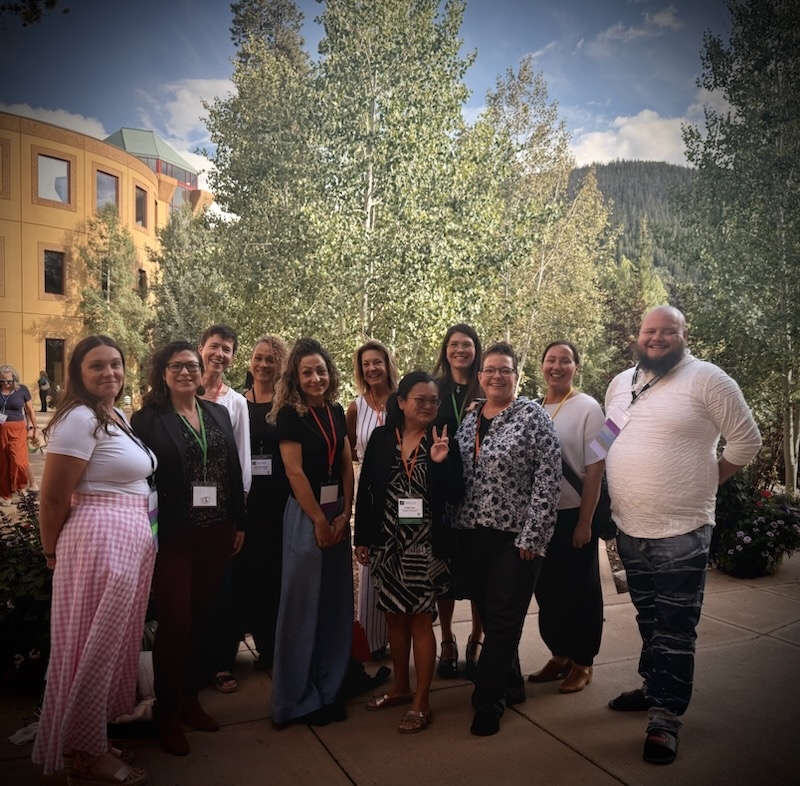
In Colorado, that evolution has meant becoming part of the backbone supporting collective efforts like Reimagining. Across the country, it has meant adapting how we show up as the work and our understanding of systems change have evolved. The model has changed. The commitment has not.
For ten years, Foster America has continued asking what it will take for children and families to thrive—and what our role must become in order to help make that future possible. Perhaps that is part of our own story of resilience.
The work of not giving up. There is something deeply human underneath systems transformation. People have to believe that another way is possible. They have to trust one another enough to try. They have to see themselves, and particularly those most affected by the system, as capable of shaping what comes next. They have to survive disappointment without becoming resigned to it. And they need structures around them that make persistence possible.
“Foster America was the backbone of Reimagining to not give up.” That isn’t simply a compliment about good facilitation or technical assistance. It’s a description of what backbone leadership can be at its best:
Holding the vision. Building the relationships. Sharing power. Turning learning into action. Adapting when necessary. And helping people find the courage and capacity to keep going.
Ten years into Foster America’s journey, that’s something worth celebrating. And as we look toward the next ten years, perhaps it is also a responsibility worth claiming: To help build the people, relationships, structures, and collective belief that make it possible for communities not to give up on creating something better for children and families.